
Njema
Njema means „good,“ „friendly,“ or „safe“ in Swahili, and that’s how we want to shape the foundation of the project. We want a good and secure foundation, based on comprehensive information. The assessment performs an automated analysis of the entire mainframe application landscape. It analyzes all software and data objects, their properties, and relationships, thus creating this essential foundation.
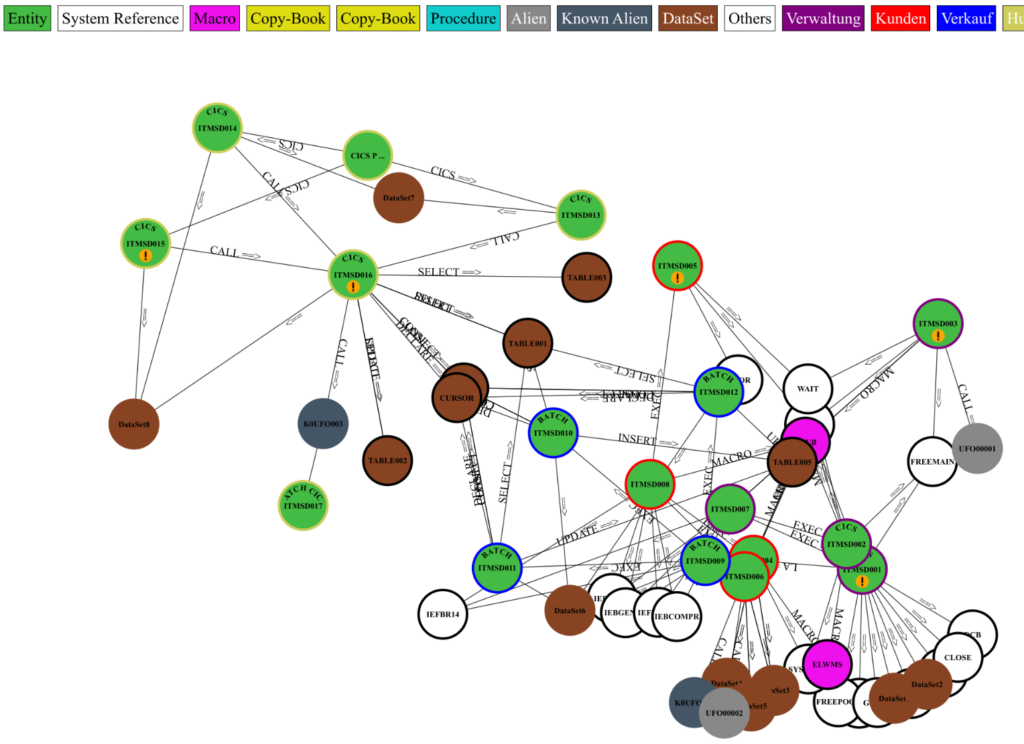
Every CIO and development manager has experienced this: after just a few weeks into a project, unexpected problems begin to emerge. No one knew that application A calls some programs from application B, or that an application indirectly uses IMS, even though it was assumed that everything ran on DB2. Or that a complex, undocumented, but essential Assembler date routine is being called, and so on.
In the end, the „small change“ or the project becomes twice as expensive and takes three times longer than planned.
This usually happens because there was simply no effective way to see all the relationships between the objects in the application landscape – whether programs, files, DB tables, fields, or jobs.
If this information had been available before,
these problems would not have occurred.
A mainframe application landscape consists of thousands of software objects: programs, COPY books, jobs, scheduling files, catalogs, online transactions, file descriptions, and more. Managing this complexity manually or semi-automatically is truly unfeasible.
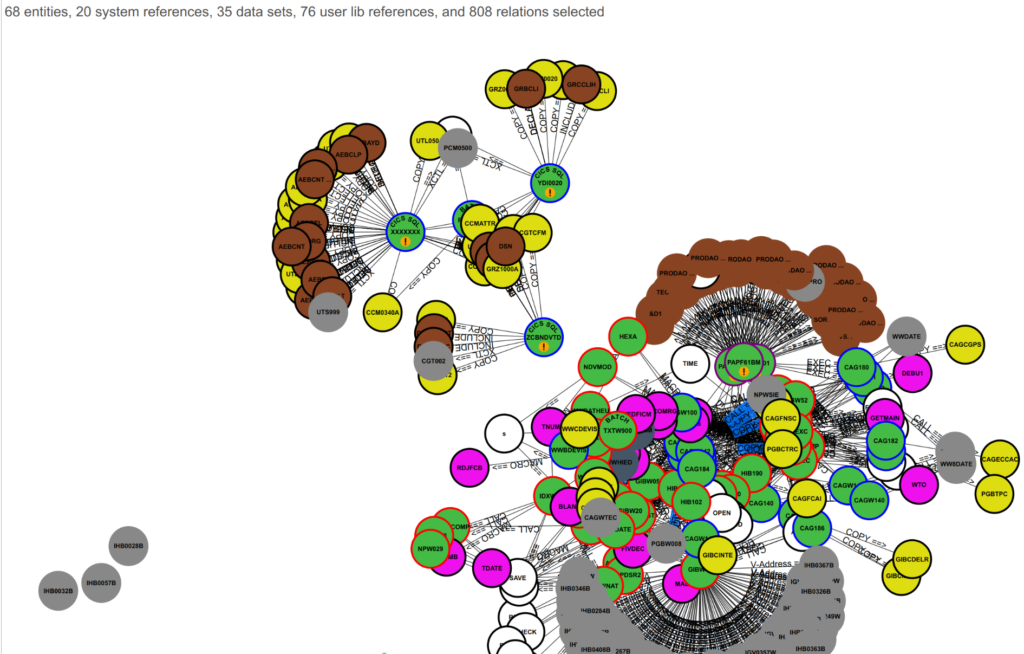
Njema eincludes parsers for a wide variety of languages – it can read Cobol and PL/I as well as Natural, Job Control (in various dialects), Assembler, Scheduler Dateien, SDF, Easytrieve, REXX, CA-Earl, DB-schemas, CICS-tables, and much more. This allows the product to perform a comprehensive analysis and build the Njema database, which contains the metadata of all objects, including their properties and relationships.
In the meantime, more than 400 million lines have been analyzed with Njema, and a large portion of them has been transformed into other languages and target architectures.
The Njema assessment has proven itself in a variety of different applcation areas. Accordingly, it is also offered in different contractual scenarios. This allows us a clear pricing as well.
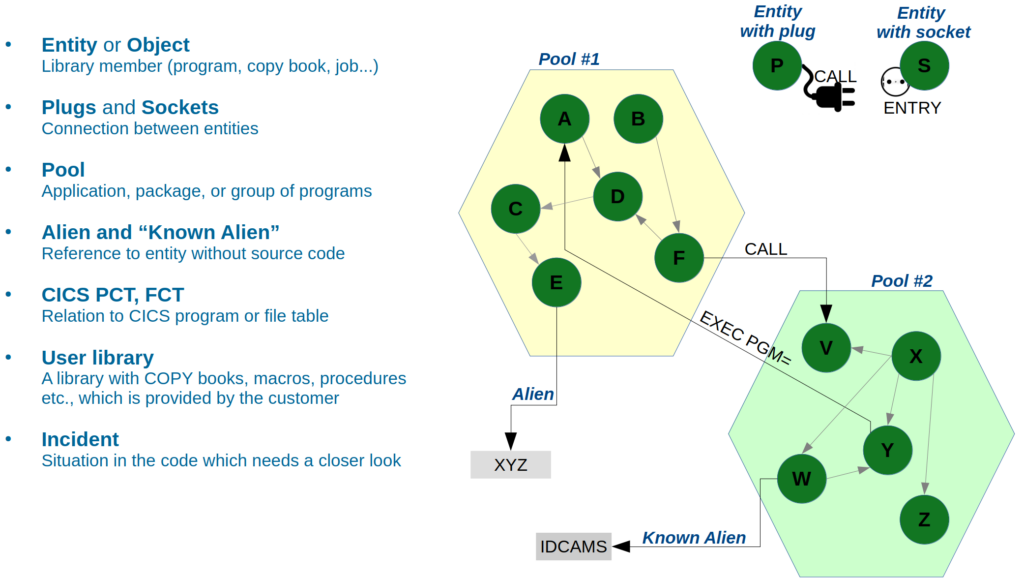
Notes on the Nomenclature Used
- A POOL is a logical grouping of entities, e.g., all PL/I programs or all procedures of application XY.
- An ALIEN is an entity for which no source code is available, and its purpose is unknown to us.
- A Known Alien is an entity whose function we know, but for which source code is not available, e.g., a utility.
- A PLUG is a construct that seeks a connection, and a SOCKET is the sought connection point.
- An INCIDENT is a code construct or situation that needs special consideration during the project, for example, requiring a workaround or needing particular attention during testing.