
Comprehensive, automated, proven, and secure
Mainframe-based systems usually have a long history of development. They have been continuously expanded and improved. Exciting technologies have emerged, opening up new business opportunities or increasing the efficiency of corporate IT.
Due to the pressure to constantly meet new business requirements, there was rarely time to replace outdated technologies and they simply had to continue running in parallel.
A colorful zoo of mainframe technologies
In our analyses, we find a different combination of technologies for each client. Here is a sample of what we have encountered or processed in recent years.
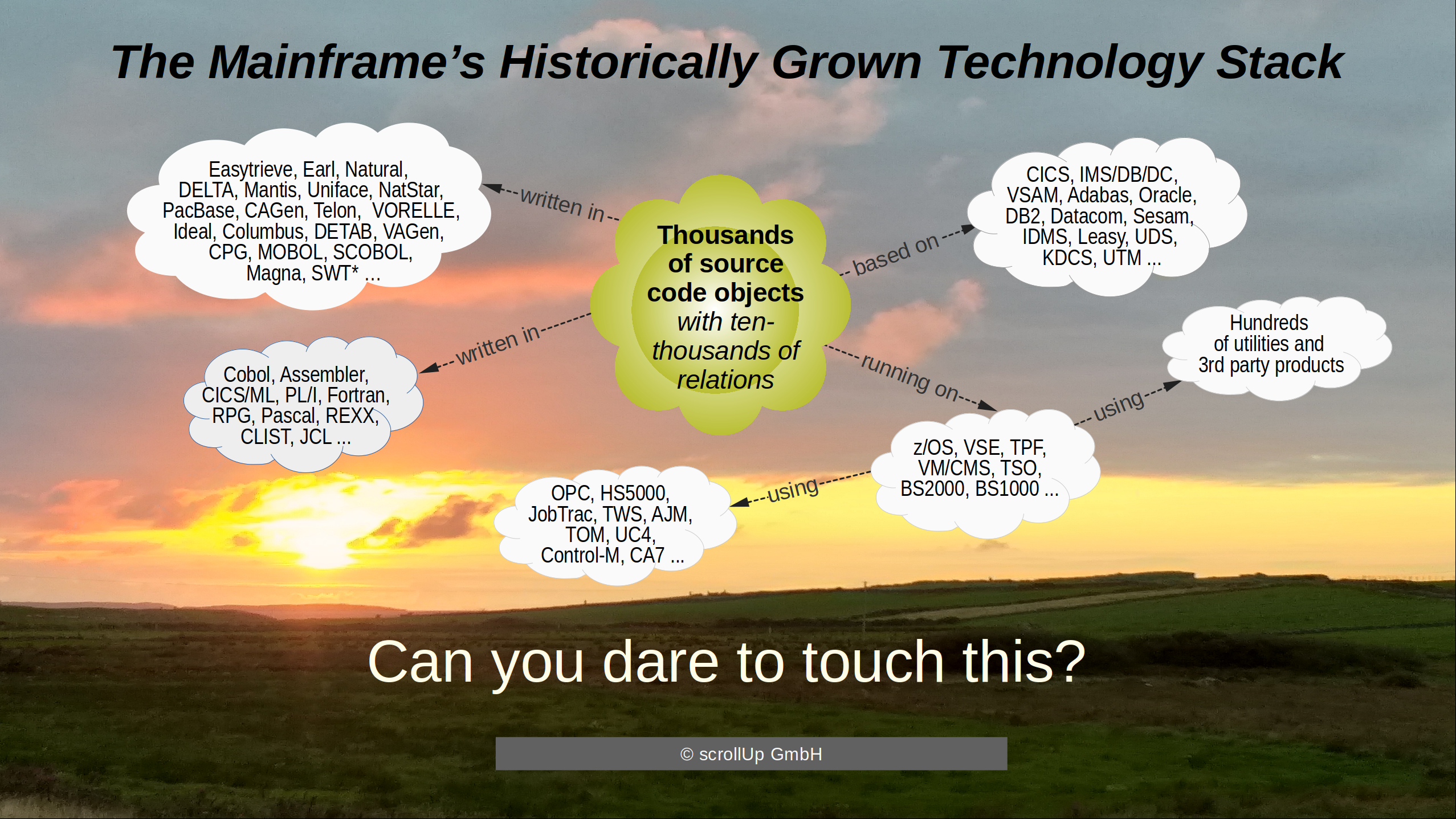
At some point, the last knowledge holders will retire, maintaining legacy systems will be costly (if at all), and a strategic modernization must be addressed.
WE are specializes in automated software processing and have developed a complete suite of software processing products. Our products cover the entire technology stack of the respective application landscape. This allows our customers to freely decide where their technological journey should take them. The products have been tested in numerous projects since 2014 and continuously expanded.
The advantages of our assessment
The standard approach to tackling a large IT project is usually a “feasibility study” in the form of an analysis or a “proof of concept”. What went wrong when costs and timelines are massively exceeded and unexpected risks arise despite this study?
The answer is simple: the problems weren’t identified until the project was already underway.
Wouldn’t it be better to know all the facts
before even starting the project?
scrollUp offers a fully automated process that processes entire mainframe systems within hours: millions of lines of code in any programming language, operating system, subsystem, database, TP monitor, and third-party software.
- Every row, all fields, data access, system tables, and system catalogs
- All relationships between all objects: programs, macros, procedures, jobs, schedules
- Missing or unused objects
- Project-specific topics
But the most important thing is:
All transformations
are performed in advance as a “dry run” during the assessment.
This allows us to identify all potential issues and obstacles before the project even begins. You can create a robust project plan and reliably estimate costs, effort, and risks.
Confidentiality
Njema has been used for assessment and transformation in many projects. All examples shown always use fictitious test data, as we never disclose customer data. We also ask for your understanding that we do not publish customer references: the results of our work are, for good reason, never accessible to third parties.
In a Nutshell
Njema, Mutabor und Rashid are universal products, that interact as a complex, heterogeneous system.
- Today, Njema covers the languages Cobol, Mainframe Assembler, Natstar, PL/I, z/OS JCL, various schedulers (TWS/OPC, JobTrac, Control-M), Easytrieve, CA-Gen, CA-Earl, PacBase, Rexx, and Natural.
Additional languages can be easily implemented using the Njema Parser Generator. - In addition, there are various online monitors and databases with their own features and APIs: IMS, DB2, CICS and UTM.
- In analysis and transformation, scrollUp supports the operating systems z/OS, VSE, BS2000, BS1000 and TPF, the OLTP systems CICS, IMS/DC and UTM/KDCS, as well as the databases DB2, Oracle, IMS, UDS, Adabas and Sesam.
- Target platforms are z/OS, VSE, Linux, and Windows. Transformation rules are stored in a Transformation Engine, which enables fully automated execution.
All steps of the analysis, code recovery, and transformation are executed fully automatically using highly complex rule sets. This also allows for cross-product operation.
This allows the load module of a lost assembler program to be reconstructed into readable code, which can then be further processed via Njema and integrated into the application. Finally, the entire application is transformed into COBOL using Rashid.
Naturally, the rules can also accommodate the specific characteristics of target systems (languages, components, frameworks, architectures, naming conventions, etc.). Macros, special coding habits, refactoring, undocumented features – everything can be taken into account.
The results of the analysis and transformation are first reviewed internally before being delivered.
- Deviations are only corrected via the rules and never manually in the result.
- Project-specific parameters and configurations, as well as new rules for special cases related to expertise and technology, are incorporated into the standard rule sets.
- Personnel support for the projects, coordination, consulting, systems for processing or data security is available to a limited extent. Consulting firms specializing in project work are the preferred option here.
- A set of refactoring rules brings the generated code into a well-structured and readable form.